What size power station for a weekend off-grid
Add up your watt-hours per day, double it for two nights, add inverter losses, then buy. Six stations from 286Wh to 2,073.6Wh.
Updated 2026-09-17
We may earn a commission if you buy through links on this page. It never changes what you pay. How we make money
Power stations are sold on peak output and photographed next to a coffee maker, but the number that decides your weekend is watt-hours. This guide is for two nights away from a hookup with a known list of things to run, whether that is a car-camping site, a driveway during an outage or a trailhead. Work out your daily watt-hours first and the price bracket picks itself.
How to decide
Build the worksheet in watt-hours: watts a device draws, times hours it runs. For a typical two-person weekend:
- 12 V fridge, 40 W nameplate. Compressors cycle rather than run flat out, so at a 40 percent duty cycle that is 40 x 24 x 0.4 = 384 Wh per day. Run the same fridge continuously in July heat and it approaches 40 x 24 = 960 Wh.
- CPAP without the heated humidifier, about 35 W for 8 hours = 280 Wh.
- Three 5 W LED lights for 5 hours = 75 Wh.
- Two phones plus a tablet = about 60 Wh.
That totals 799 Wh a day, so call it 800. Two nights is 1,600 Wh of delivered energy, and that is not the same as 1,600 Wh of battery. Anything plugged into an AC outlet goes through the inverter, which is roughly 85 percent efficient, so you need 1,600 divided by 0.85, or about 1,880 Wh in the pack. Only the Elite 200 V2 at 2,073.6 Wh covers that on one charge. The 1,024 Wh and 1,070 Wh units cover one night of the same list and need a top-up before the second.
Drop the fridge and the math changes bracket. CPAP, lights and phones are 415 Wh a day, so two nights is 830 Wh, or 976 Wh after inverter losses, which the DELTA 3 at 1,024 Wh clears by about 5 percent and the Explorer 1000 v2 at 1,070 Wh by about 10 percent. Drop the CPAP too and a weekend of lights and phones is 135 Wh a day: 270 Wh over two nights, or 318 Wh through the inverter. That is slightly more than either of the small stations holds, and they are one-night boxes unless you can recharge.
Check output as well as capacity, because watt-hours say how long and watts say whether. A 1,500 W electric kettle will not start on a 300 W, 600 W or 1,000 W inverter no matter how full the battery is; it needs the Explorer 1000 v2's 1,500 W rated output at the very limit, or the DELTA 3's 1,800 W rated with margin to spare. Run that kettle for 6 minutes and it eats 1,500 x 0.1 = 150 Wh, about a seventh of the DELTA 3's 1,024 Wh.
Then plan the refill, since recharge speed is what turns a one-night station into a weekend one. The DELTA 3 takes 1,500 W from a wall outlet and refills 1,024 Wh in 56 minutes, and the Elite 200 V2 reaches 80 percent in 1.1 hours. Away from a wall, a 12 V car socket is usually limited to about 100 W, so putting 1,000 Wh back means more than 10 hours of driving. Solar is the other lever: a 100 W panel in 4 peak sun hours returns roughly 300 Wh a day, which covers lights and phones but not a fridge.
Compared
| Pick | Capacity | AC output | Weight | Wall recharge | Price |
|---|---|---|---|---|---|
| EcoFlow RIVER 3 Max | 286Wh, to 858Wh with the extra battery | 600W rated, 1200W X-Boost | 10.4 lbs | 380W in, 0-100% in 60 min | $499.00 |
| Jackery Explorer 300 v2 | 288Wh | 300W rated, 600W surge | 8.16 lbs | 80% in 1 hour | $269.00 |
| BLUETTI AC70 | 768Wh | 1,000W, two 120V outlets | 22.5 lbs | 850W turbo, 45 min to 80% | $359.00 |
| EcoFlow DELTA 3 | 1024Wh | 1800W rated, 3600W X-Boost | 27.6 lbs | 1500W in, 0-100% in 56 min | $629.00 |
| Jackery Explorer 1000 v2 | 1070Wh | 1500W rated, 3000W surge | 23.8 lbs | 1.58 hours to full | $559.00 |
| BLUETTI Elite 200 V2 | 2,073.6Wh | 2,600W, 3,900W lifting mode | 53.4 lbs | 80% in 1.1 hr, full in 1.4 hr | $849.00 |
The picks

RIVER 3 Max (RIVER 3 Plus + Extra Battery 300)
Covers a weekend of light device charging where a compact, sub-15 lb station matters more than big appliance runtime.
- Capacity:
- 286Wh (expandable to 858Wh with an extra battery)
- AC output:
- 600W rated, 1200W X-Boost surge
- Weight:
- 10.4 lbs
- Wall recharge:
- 380W AC input, 0-100% in 60 min
About $499.00 (checked 2026-09-17)
Check price at EcoFlowThis is the one to carry rather than the one to rely on, and the expansion battery is the reason it is in this guide: 286 Wh alone is a night of lights and phones, while the extra battery takes it to 858 Wh and into fridge territory for a night. At 10.4 pounds it goes in a pannier or a boat locker without planning. What it gives up is appliance headroom, since 600 W rated output rules out kettles and most microwaves even with X-Boost.
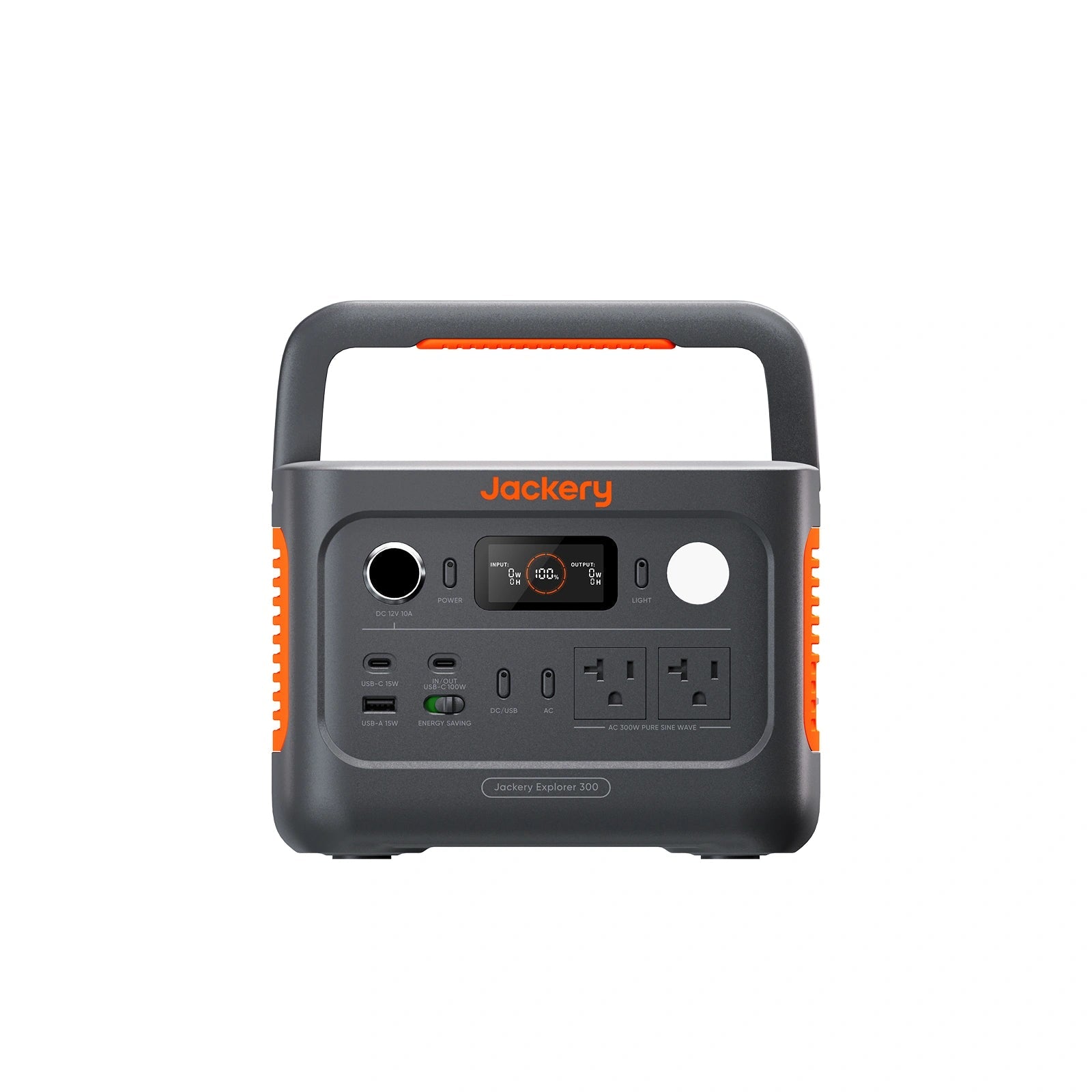
Jackery Explorer 300 v2 Portable Power Station
Small enough to grab for a single weekend trip charging phones, lights and a mini cooler.
- Capacity:
- 288Wh
- AC output:
- 300W rated, 600W surge peak
- Weight:
- 8.16 lbs
- Wall recharge:
- 80% in 1 hour
About $269.00 (checked 2026-09-17)
Check price at JackeryAt 8.16 pounds this is the lightest thing here and the cheapest at $269.00, which makes it the right call for phones, a laptop and a string of lights. Its 288 Wh is roughly two days of that 135 Wh list, so it fits a weekend as long as nothing with a heating element joins the trip. The 300 W rated inverter is the real limit: it will not run a kettle, a hair dryer or most coffee makers.

BLUETTI AC70 Portable Power Station
Handles a couple of nights off-grid running a mini fridge or CPAP on a single charge.
- Capacity:
- 768Wh
- AC output:
- 1,000W (two 120V outlets)
- Weight:
- 22.5 lbs
- Wall recharge:
- 850W Turbo Charging, 45 min to 80%
About $359.00 (checked 2026-09-17)
Check price at BLUETTIThe AC70 roughly doubles the output of the small units, with 1,000 W across two outlets and 768 Wh behind it. That is about one night of the full fridge-plus-CPAP list, or two nights of the lighter one, and the 45 minute turbo charge to 80 percent means a lunch stop refills most of it. What it gives up is the second night: 768 Wh runs out around hour 23 of a 40 W duty-cycled fridge plus a CPAP.
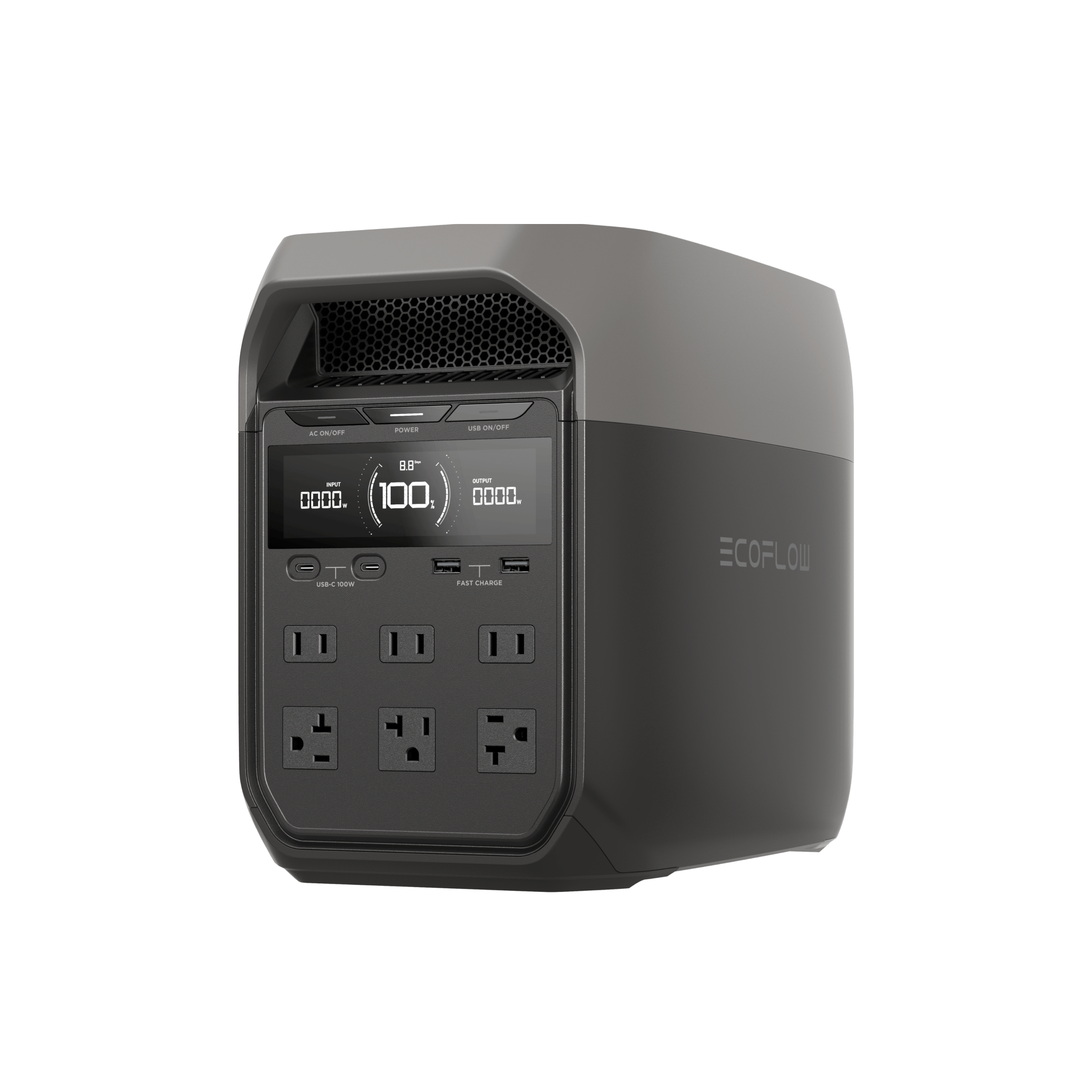
EcoFlow DELTA 3 Portable Power Station
Backs up a fridge or CPAP through a multi-day outage without the size of a whole-home unit.
- Capacity:
- 1024Wh
- AC output:
- 1800W rated, 3600W X-Boost surge
- Weight:
- 27.6 lbs
- Wall recharge:
- 1500W AC input, 0-100% in 56 min
About $629.00 (checked 2026-09-17)
Check price at EcoFlowWith 1,024 Wh and 1,800 W rated output, the DELTA 3 is the smallest unit here that behaves like an outlet: it starts a microwave, a coffee maker or a 1,200 W induction burner. Its 1,500 W input refills the whole pack in 56 minutes, which matters more than capacity when you have any access to shore power. At 27.6 pounds it is heavier than the Jackery that holds slightly more.
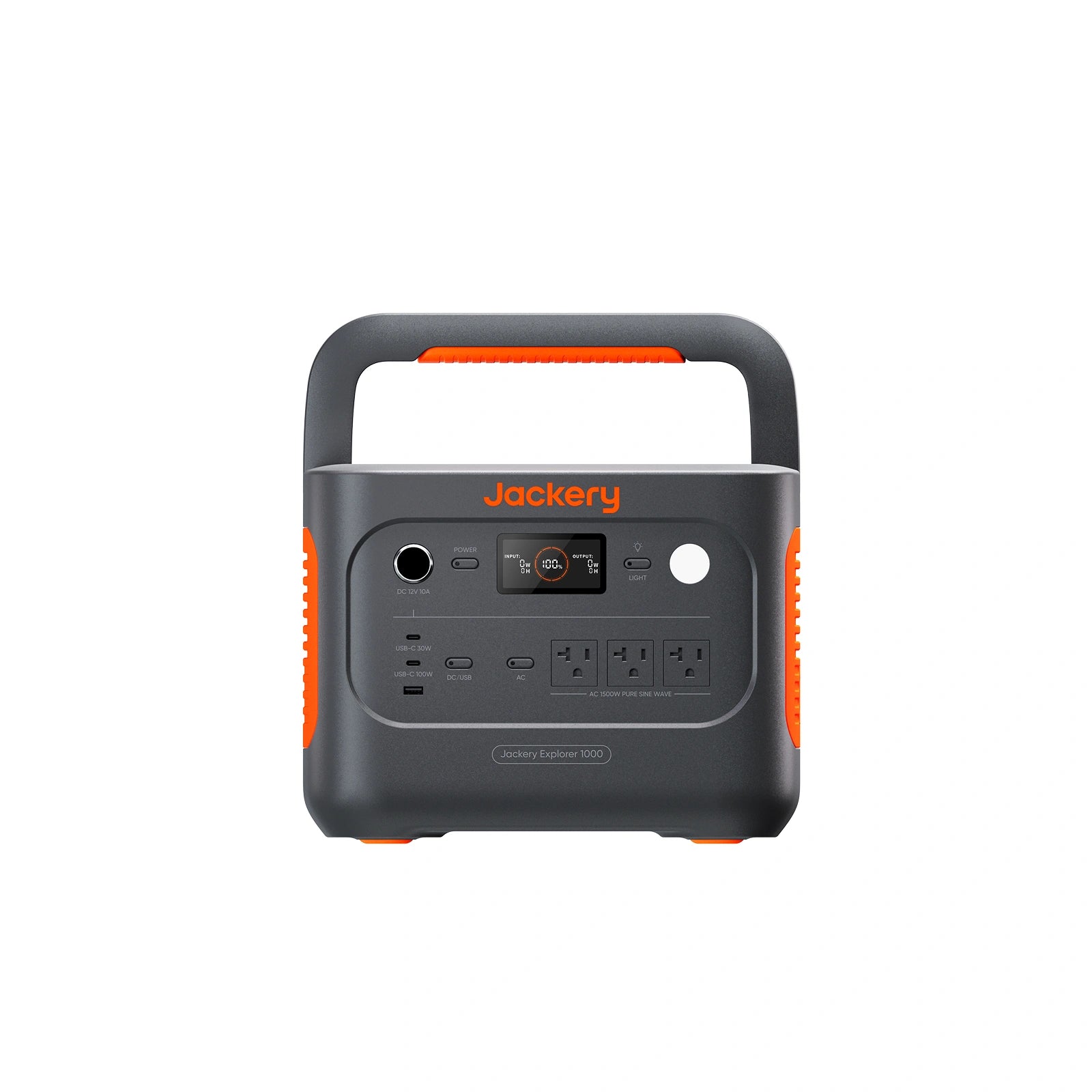
Jackery Explorer 1000 v2 Portable Power Station
Covers a family car-camping trip running a cooler and lights for several nights off one charge.
- Capacity:
- 1070Wh
- AC output:
- 1500W rated, 3000W surge peak
- Weight:
- 23.8 lbs
- Wall recharge:
- 1.58 hours to full via AC adapter
About $559.00 (checked 2026-09-17)
Check price at JackeryThe Explorer 1000 v2 packs 1,070 Wh into 23.8 pounds, which works out to about 45 Wh per pound, the best energy-to-weight ratio in this group. That combination suits a trip where the station gets lifted in and out of a trunk daily and still has to run a cooler and lights for two lighter nights. Its 1,500 W rated output covers most kitchen appliances, and a full refill takes 1.58 hours. What it gives up against the DELTA 3 is charge speed and surge headroom.

BLUETTI Elite 200 V2 Portable Power Station
Keeps a full fridge and a few essentials running through several days off-grid or during an outage.
- Capacity:
- 2,073.6Wh
- AC output:
- 2,600W continuous (3,900W Power Lifting mode)
- Weight:
- 53.4 lbs
- Wall recharge:
- TurboBoost: 80% in 1.1 hr, full in 1.4 hr
About $849.00 (checked 2026-09-17)
Check price at BLUETTIThis is the only station here that runs the full worked example above, a duty-cycled fridge plus a CPAP plus lights and phones, for two nights on one charge, with 2,073.6 Wh and 2,600 W of output. It is also the heaviest thing here: 53.4 pounds is a two-hand lift. For a trailer or a driveway during an outage that is the right trade, especially with 80 percent back in 1.1 hours. For a tent site you walk gear into, it is too much.
What we'd skip
Skip the bargain "solar generator" bundles that advertise capacity in milliamp-hours and ship with a 20 W panel. A 60,000 mAh figure sounds enormous but at 3.7 V per cell it is about 222 Wh, less than the smallest station here, and the bundled panel returns roughly 60 Wh on a good day, which will not keep up with a CPAP let alone a fridge. If a listing will not state watt-hours and rated inverter watts, you cannot do the arithmetic, and the arithmetic is the whole job.
FAQ
what size power station do i need for camping
Add up watts times hours for everything you plan to plug in, multiply by the number of nights, then divide by 0.85 for inverter losses. Lights and phones land near 135 Wh a day, adding a CPAP pushes it to about 415 Wh, and adding a 12 V fridge puts it near 800 Wh. That last case needs roughly 1,900 Wh for two nights, which is a 2,000 Wh class station.
how long will a power station run a cpap
A CPAP without the heated humidifier draws about 35 W, so 8 hours is 280 Wh, and after inverter losses it pulls roughly 330 Wh from the pack. A 768 Wh AC70 covers two nights of that alone; a 288 Wh unit does not cover one. Turn the humidifier on and expect the draw to double.
can you charge a power station while driving
Yes, but slowly. A 12 V car socket is generally limited to about 100 W, so a 1,024 Wh station needs more than 10 hours of driving to fill from empty. If you need meaningful range between sites, either wire a higher-current DC input or bring a panel.
Specs and prices come from each retailer's product page on the date shown on the card. This is a research-based comparison, not a hands-on test.
Products in this guide
- RIVER 3 Max (RIVER 3 Plus + Extra Battery 300) — EcoFlow
- Jackery Explorer 300 v2 Portable Power Station — Jackery
- BLUETTI AC70 Portable Power Station — BLUETTI
- EcoFlow DELTA 3 Portable Power Station — EcoFlow
- Jackery Explorer 1000 v2 Portable Power Station — Jackery
- BLUETTI Elite 200 V2 Portable Power Station — BLUETTI